
The Algorithm Cannot Preserve a Ghost
On streaming, licensing, and the quiet difference between finding a movie and keeping it.

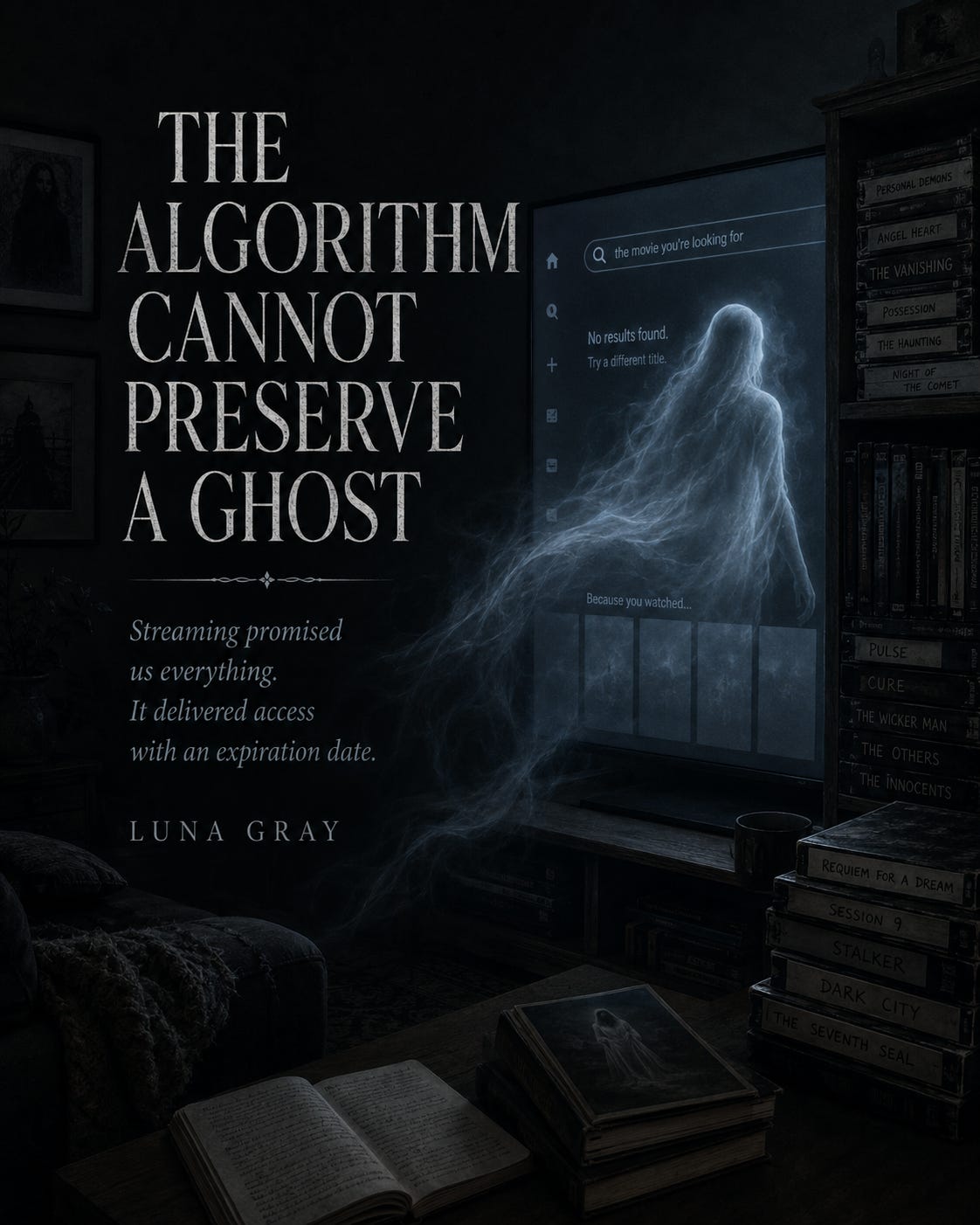
You go looking for a film you have seen a dozen times. Maybe it is late, maybe you want it playing in the corner while you do something else, maybe you finally want to show it to a friend who will not shut up about how they love horror. You type the title into the search bar of whatever service you are paying for this month, and the little wheel spins, and then it offers you three things that are not the film. It offers you something with a similar title. It offers you something in a vaguely similar mood. It offers you a reality show. It does not offer you the movie, because the movie is not there.
There is no message. Nothing tells you the film left. There is no small ceremony, no note taped to the shelf, no gap where the case used to sit. The interface simply reorganizes itself around the absence as if the absence were the natural state of things. Yesterday it was there. Today it behaves as though it was never there at all, and the only person who remembers otherwise is you.
This is the part that unsettles me more than any jump scare. I know how to grieve a thing that is gone. What I do not know how to do is grieve a thing that still exists somewhere, fully intact, in a vault or on a server or inside a licensing spreadsheet, but is no longer available to me. The film has not died. It has become a ghost, present in the world, absent from the room, reachable only by people who happened to keep a body.
For years we were told, gently and constantly, that this would not happen. The promise of streaming was totality. Everything, all of it, one search away, forever. It is worth noticing how completely that promise dissolved, and how quietly. Believing a movie is available is not the same as having access to it, and having access is not the same as owning it. Those distinctions used to feel pedantic. Now they feel like the whole game.
Renting from a landlord who keeps rearranging the house
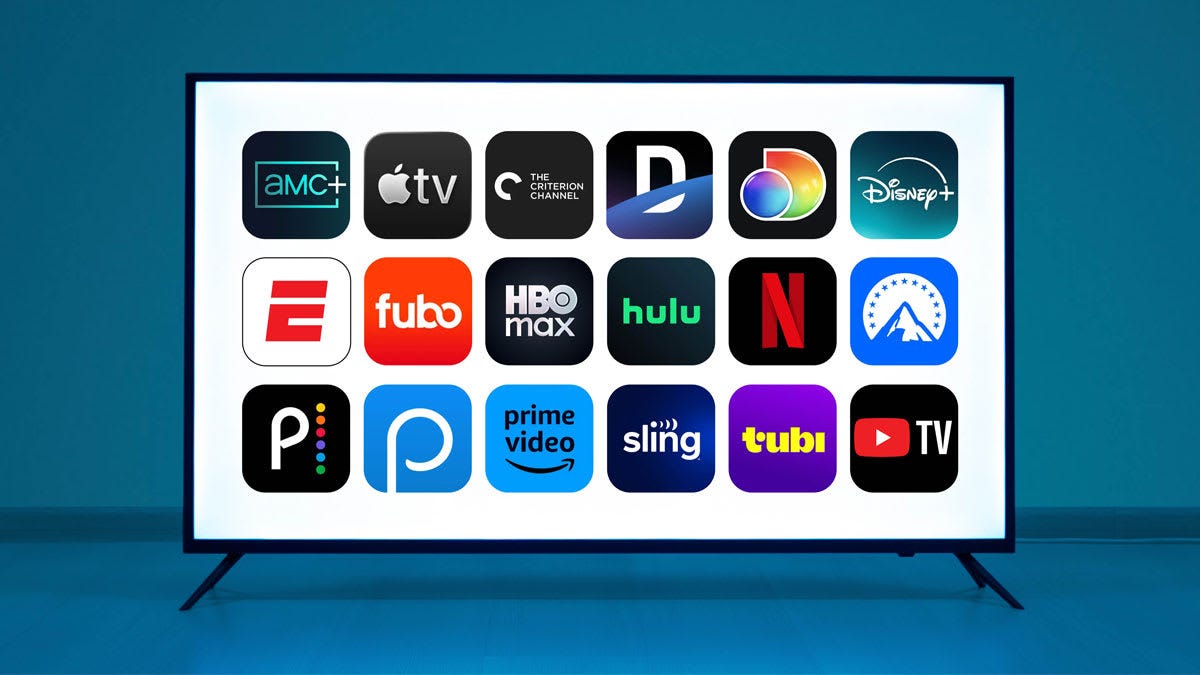
Here is the thing the interface is very good at hiding. When you open a streaming app, it looks like a library. Your library. There is a row that says Continue Watching, which sounds like a promise. There is a section called My List, which uses a possessive pronoun it has not earned. The visual language is all ownership and permanence, shelves and collections, a home you have furnished.
What you actually have is a rental, and not even a rental of the films. You are renting access to a catalog that a company assembles out of temporary licensing agreements, and that company can rearrange the furniture, or remove it entirely, without telling you and without owing you an explanation. The titles blink in and out based on what a distributor will lease, what a rival will outbid, what a merger reshuffled, what a regional rights deal permits in your country but not the one across the border. None of that is visible from your couch. You see a movie, and then one day you do not.
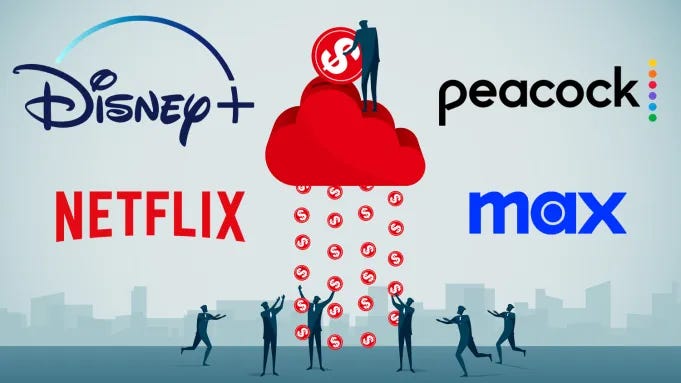
We got an unusually honest look at how this works in 2022, when Warner Bros. Discovery, freshly merged and looking for savings, began pulling titles from HBO Max and writing them off. Finished films were shelved for tax purposes. A nearly completed Batgirl was scrapped and reportedly treated as a write-down rather than released. Six Warner Bros. streaming-exclusive movies were quietly removed. Series that had lived on the platform, Westworld among them, were pulled and eventually licensed out to free ad-supported channels. The company later insisted that this particular chapter was closed, which is the kind of reassurance that only makes sense if you accept that the chapter was possible in the first place.
And it was possible. It remains possible. That is the point that survives any specific title or any specific quarter. The system is not built to keep a film available because the film is good, or beloved, or historically important. It is built to keep a film available for exactly as long as availability serves the ledger. When it stops serving the ledger, the film does not get a send-off. It gets removed the way a landlord removes a couch from a staged apartment, because the couch was never yours and the apartment was never a home.
Horror has always survived through obsessive people
Here is where I stop pretending to be surprised, because horror fans have seen this movie before. The genre has spent its entire life being treated as disposable, and it survived anyway, almost entirely because certain people refused to let it go.
Consider what happened in Britain in the early 1980s. A moral panic over what the press called video nasties, stoked by campaigners like Mary Whitehouse, led to the Video Recordings Act of 1984 and a list of dozens of films, seventy-two at its peak, pursued and prosecuted as obscene. Sam Raimi’s The Evil Dead, a film whose sense of humor should have been legible to anyone who watched it awake, spent time on that list before being removed. Others stayed banned or butchered for years. What is worth remembering is not just the censorship. It is what the censorship failed to accomplish. The films did not vanish. They circulated. People held onto tapes, imported uncut copies from other countries, passed knowledge hand to hand about which version was which and what had been cut from where. The official record said these movies should not exist in full. The unofficial network of people who cared said otherwise, and the unofficial network won.
That pattern is the actual history of horror preservation, and it is not a flattering one for institutions. Cult films stayed culturally alive because video store clerks recommended them, because collectors kept them, because repertory theaters kept booking them, because someone set a VCR to record a late-night broadcast and labeled the tape in ballpoint pen. A great deal of what we now treat as canon was kept breathing by amateurs operating outside anything you could call an archive.
I want to be careful here, because there is a romantic version of this story that slides straight into cheerleading for piracy, and that is not what I am doing. Unofficial circulation has always been legally and ethically tangled, and a bootleg is not a preservation strategy you can build a culture on. But it is dishonest to pretend the genre would be intact without the people who, for decades, simply declined to accept that a film was gone just because the people who owned it had lost interest. Obsessives kept the lights on. They usually do.
The algorithm does not remember, it recommends
Now put that history next to the machine we have handed the job to, and the mismatch becomes almost funny.
A recommendation algorithm is often described as if it were a kind of memory. It is not. Memory holds onto things because they mattered, sometimes long after they stop being useful, sometimes precisely because they are useless and beloved. An algorithm holds onto nothing. It surfaces what is licensed right now, trending right now, likely to keep you on the platform for the next forty minutes right now. It is a machine for predicting the immediate future of your attention, and it is unnervingly good at that. It is also completely indifferent to whether a film exists tomorrow.
This is the clearest way I know to explain the title of this essay. A ghost persists because someone remembers it. That is the whole mechanism. The dead stay present through the stubborn attention of the living, through the story retold, the name spoken, the ritual repeated so the thing is not allowed to fully disappear. An algorithm does none of that. It does not remember a film. It displays whatever it has been instructed to keep visible, and it stops displaying whatever it has been instructed to drop. It has no attachment, no loyalty, no sense that a difficult, unprofitable, half-forgotten movie might be exactly the one worth keeping. Ask it to preserve a ghost and it will show you the three most popular ghosts of the quarter and quietly delete the one nobody clicked.
That is not a flaw in the code. It is the code working. The trouble is only that we mistook it for a librarian, when it was always a shopkeeper rearranging the window.
The imperfect case for physical media

So we arrive, a little reluctantly, at the disc on the shelf. And I want to make the case for it honestly, which means making it smaller than the collectors would like.
A physical release, at its best, does something streaming structurally cannot. It does not just give you the movie. It gives you the movie plus the argument for why the movie matters. Look at what the boutique labels actually do. Vinegar Syndrome, founded in 2012, exists specifically to rescue and restore cult and exploitation films that had rotted into obscurity, many of which had not been available in any form since VHS, if they had ever been available at all. Severin, Arrow, Scream Factory, and the American Genre Film Archive do versions of the same work: locating original elements, funding restorations, and then wrapping the film in commentary tracks, printed essays, interviews, and alternate cuts. The disc becomes a small act of scholarship. It preserves the film and the context around the film in the same object.
The single best example I know is Nightbreed. Clive Barker’s 1990 film was mangled by its studio into something incoherent, and for years the fuller version was a rumor traded among fans as the Cabal Cut. That fan pressure is what eventually sent Scream Factory and Morgan Creek digging through the Warner archives, combing, by the account of the people involved, through hundreds of boxes to find the long-missing footage. The 2014 director’s cut that resulted did not exist because an algorithm noticed demand. It existed because obsessives would not let the fuller film stay a ghost, and because a physical release was the vessel capable of holding it. You cannot silently pull that disc out of someone’s house because a contract lapsed. It sits there, uncut, indifferent to the ledger.
Now the honest part, because I promised. Physical media is expensive, and the good editions are frequently limited, which shades quickly into a collector market that treats scarcity as a feature and prices accordingly. Discs take up space, and they are region coded in ways designed to frustrate you. And they are not immortal. DVDs succumb to disc rot, tapes shed their oxide and warp, and the machines that read them are themselves quietly going extinct. A shelf of horror is not a vault. It is a slower, more personal form of decay, and anyone who tells you that buying a 4K restoration is a political act has usually got a shelf to sell you.
The case is narrower than that, and sturdier for being narrow. A physical object is fragile in every way a license is not, but it has one property a license will never have. It cannot be revoked from across the country by a company that changed its mind. Its failure mode is entropy, not deletion. That is a real difference, and it is the only difference the argument actually needs.
Becoming an accidental archivist
Which brings me back to us, the people who love this genre and have somehow, without applying for the job, become responsible for its memory.
You do not need a climate-controlled vault to take part in this. The romance of the lone collector with a wall of rare discs is mostly beside the point, and often just another way to spend money. Preservation, the real and unglamorous version, is a set of small habits distributed across a lot of people. Keeping the disc of the film you love instead of assuming the cloud has it covered. Buying the legitimate restoration when a label does the expensive work of pulling a movie back from the edge, so that the work stays economically possible. Going to the repertory screening. Borrowing from a library, which remains one of the few institutions built to hold things because they matter rather than because they sell. Writing down what you know about an obscure release before the knowledge leaves with you. Telling someone about a film they will never otherwise find, which is the oldest preservation technology there is and still the most reliable.
The goal is not to own everything. That is a hoarder’s fantasy and a marketer’s dream, and it is not available to most people anyway. The goal is smaller and more stubborn. It is to stop assuming that availability will take care of itself, because it will not, and it never has.
Closing image
So go back, one more time, to the search bar and the spinning wheel and the movie that is no longer there. Sit with how quiet it was. No announcement, no funeral, no empty space on a shelf to mourn in front of. Just a title that stopped returning results, and the private, slightly crazy-making certainty that it used to.
Horror fans, of all people, should recognize the shape of this. We have spent our lives with stories about what happens when the dead are not properly remembered, when the rituals lapse and the name goes unspoken and the thing is allowed to slip out of the world without anyone marking the passage. The whole genre is, in a sense, an argument that remembrance is work, and that the work is not optional, and that something is lost when we assume the dead will keep themselves present.
London After Midnight burned in an MGM vault in 1965, and no one has seen the film since. What survives is a reconstruction stitched together from stills, kept alive by people who refused to let even the memory of it go dark. That is what preservation looks like when it fails, and it is also what devotion looks like when it does not. The films we love are not safe simply because we can currently find them. They persist for exactly as long as someone insists on remembering, and not one minute longer. The machine will not do the insisting for us. It was never built to. It only shows us what it has been told to keep visible, and it has never once been haunted by anything.